
The Hidden Cost of Disconnected Systems in Franchise Operations

Introduction
Ask most franchise executives what their biggest technology challenge is, and you’ll hear about specific platforms: a POS that’s aging out, a CRM that doesn’t quite fit, a reporting process that takes too long. What you’ll hear less often is an honest accounting of what it costs when those systems don’t work together.
We’ve sat across the table from franchise leadership teams who were tracking IT costs carefully and still had no idea how much their disconnected systems were costing them. Not because they weren’t paying attention, but because those costs don’t appear on a software invoice. They appear in labor hours spent moving data by hand, in errors that compound quietly across dozens of locations, in decisions made on information that was already a week old, and in franchisees quietly losing confidence in the tools they’ve been asked to use.
Disconnected technology is one of the most common and most expensive problems in franchise operations and it’s one of the hardest to see clearly; because the pain is distributed across too many people and processes to add up easily.
This post is about making those costs visible and understanding what a more connected franchise technology environment can actually look like.
The Franchise Pain Point
What "Disconnected Systems" Actually Means
Disconnected systems aren’t just platforms without a direct integration. In a franchise context, disconnection shows up in several forms, some obvious, some easy to miss:
Data that lives in silos. Your POS captures transaction data. Your CRM holds customer information. Your operations platform tracks franchisee activity. Your marketing tools measure campaign performance. When these systems don’t share data, the full picture of the business only exists in someone’s head or in a spreadsheet someone built to pull it together manually.
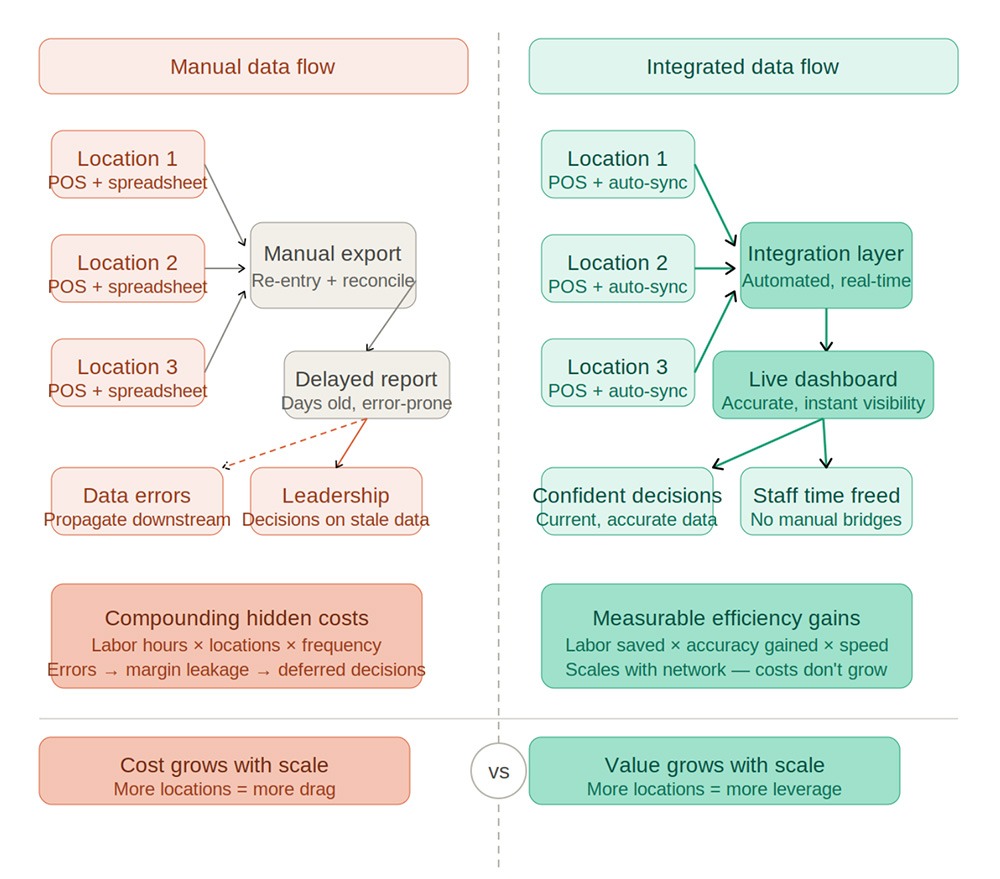
Processes that require a human bridge. Anytime a person has to export data from one system and import it into another, re-enter the same information in two places, or copy figures from one report into another document that’s a manual bridge filling a gap that technology should close.
Reporting that requires assembly. When producing a meaningful view of business performance means pulling from multiple sources, reconciling inconsistencies, and formatting the result for an audience that just wants to understand what’s happening, the systems are creating work rather than enabling insight.
Franchisees operating without the visibility they need. When location-level teams don’t have access to the information needed to run their business well, because the right data is locked in a corporate system or buried in a format no one can act on, operational consistency suffers quietly across the network.
How Disconnection Compounds at Scale
In a single-location business, a disconnected system is an inconvenience. In a franchise network with dozens or hundreds of locations, it’s a multiplier.
Every manual process that exists because two systems don’t communicate doesn’t happen once. It happens at every location, every day, every reporting cycle. A workflow that adds 30 minutes of administrative work per week per location becomes thousands of hours annually across a mid-size franchise system. That’s time that isn’t being spent on the work that actually builds the business.
The compounding effect goes beyond labor. When data passes through manual steps, errors enter the system. When those errors aren’t caught, and in high-volume environments they often aren’t, they affect decisions made downstream. Royalty calculations, inventory management, performance benchmarking, customer data accuracy: all of it degrades when the underlying data moves through human hands between systems.
The Tsource Perspective
Making the Hidden Costs Visible
The first thing we do when a franchise system comes to us with a technology challenge is to understand what disconnection is costing them. Not in theory, but in practice. That means mapping where data is being moved by hand, how long it takes, how often errors occur, and what decisions are being delayed or distorted as a result.
For many organizations, that exercise is the first time anyone has put a real number on the problem. And the number is almost always larger than expected.
Here’s how we think about identifying and addressing the most costly forms of disconnection:
Identify the manual middle layer first
The highest-priority integration targets are almost always the processes where someone is manually moving data between systems. These carry both labor cost and error risk and they’re usually the most visible once you start looking for them. We ask: where is data being re-entered, reconciled, or reformatted? Those are your starting points.
Understand what decisions are being made on incomplete information
Delayed reporting and siloed data don’t just create operational friction they create decision risk. When leadership is working from information that’s two weeks old, or from reports that had to be manually assembled and may contain reconciliation errors, the quality of those decisions suffers. We look for the places where real-time data access would change how the business responds to what’s happening.
Prioritize by impact, not by complexity
Not every integration delivers equal value, and not everything can be connected at once. We help franchise systems prioritize integration work by the number of people it affects, the frequency of the process, and the downstream cost when it breaks down. Starting with the highest-impact gaps produces visible results quickly and builds the case for continued investment.
Build integrations that scale with the network
In franchise systems, integrations aren’t just a technical exercise, they need to be designed for the reality of a growing network. An integration that works cleanly at 50 locations should work just as cleanly at 200. That means building with scalability in mind from the start, rather than solving for today and creating a new problem tomorrow.
Ask us about a Scale Ready Jumpstart — we can help you map your current disconnection points and identify where integration investment will deliver the most immediate value.
Real-World Application
From Pricing Chaos to Real-Time Control: A Healthcare Franchise Case Study
A national healthcare franchise network with over 200 locations came to us with a disconnection problem that had grown too large to manage manually. Their model offered consumers direct access to lab testing, a catalog of more than 8,000 tests across approximately 30 lab partners, with pricing that varied by market area and by individual franchise location.
The result was hundreds of spreadsheets, maintained independently across 200 locations. Each location was responsible for managing its own pricing across all lab partners, tailored to local market conditions. Corporate had no reliable way to enforce pricing standards or identify margin leakage. When a lab partner changed a test price, that change had to be pushed manually through hundreds of pages, internal systems, and point-of-sale configurations across every affected location. A process that should have taken minutes was consuming most of a webmaster’s week and errors were frequent.
Before engaging Tsource, they evaluated SaaS pricing platforms. But the per-seat licensing model exposed a structural cost problem: every new franchise location added approximately $1,140 in permanent annual software expense. Projected over three years, SaaS licensing alone would approach $895,000, before integration fees or price increases.
Working with Tsource, they chose a different path: a purpose-built Pricing Portal designed specifically for how their franchise system operates, developed in phases starting with a minimum viable product.
The MVP was live within four months at a fraction of the projected SaaS cost. The full production system followed within twelve months. Pricing updates that previously took days now happen in real time. Corporate gained centralized visibility and control over the full test catalog, while franchisees retained the ability to negotiate better local pricing within defined guardrails. The webmaster’s time shifted from manual updates to strategic website initiatives.
The financial outcome was significant. Over three years, the custom solution delivered estimated savings of $415,000 to $570,000 compared to the SaaS alternative, with costs declining as the system matured, rather than growing with each new location.

The CEO reflected on the partnership:


“Tsource has been a wonderful addition to our team. With their vast knowledge and experience, we have been able to improve our technology infrastructure and get franchisee buy-in on our technology objectives.”
Takeaways and Action Steps
What to Walk Away With
- Disconnected systems have a real cost, it’s just hidden. Labor hours, error rates, delayed decisions, and margin leakage don’t appear on a software invoice, but they compound over time and across locations.
- The cost multiplies with scale. Every manual process that exists because two systems don’t communicate happens at every location, every cycle. The larger the network, the larger the drag.
- Start by mapping the manual middle layer. The processes where someone is manually moving data between systems are your highest-priority integration targets, they carry both labor cost and error risk.
- Integration doesn’t always mean replacement. Many of the most impactful improvements connect or extend what already exists, rather than requiring a wholesale platform change.
- Scalability matters from day one. Integrations designed for today’s location count will create tomorrow’s problem if they aren’t built to grow with the network.
The hidden cost of disconnected systems is real. For franchise systems operating at scale, the question isn’t whether integration is worth the investment, it’s how much the lack of it is already costing.

FAQs
Start by asking your operations and finance teams where they spend time moving, reformatting, or reconciling data by hand. Those manual steps almost always exist because two systems that should communicate don’t. Mapping those workflows, even informally, gives you a starting point for prioritizing integration work.
It depends on the systems involved and the complexity of what needs to flow between them. Pre-built connectors work well for common platform combinations. For franchise-specific workflows with unique data structures or requirements, a custom integration often delivers a more reliable and scalable result. A good technology partner can help you evaluate which approach fits your situation.
Integration costs vary significantly based on the platforms involved, the complexity of the data flows, and the volume of what needs to be connected. The more useful framing is: what does the current disconnection cost in labor, errors, and delayed decisions? That baseline usually makes the investment case clear.
Integration focuses on connecting existing systems so data flows reliably between them without manual intervention. Custom application development involves building new tools or interfaces, often on top of those integrated systems, to support workflows that existing platforms can’t handle. In practice, the two often work together.