
The Hardest Part of a Technology Roadmap Has Nothing to Do With Technology

Introduction
Franchise leaders often tell us that the hardest part of building a technology roadmap is knowing where to start. And that is a real challenge, one worth taking seriously. But in our experience, it is rarely the hardest part of the process overall.
The hardest part comes later. It comes when the roadmap is built, the investments are approved, and the new system is ready to roll out. Without proper buy in and communication, the franchisees who were supposed to embrace it push back instead, quietly ignore it, or adopt just enough of it to satisfy a checkbox while continuing to run their location the way they always have.
Technology that franchisees do not use does not solve the problem it was built to solve. In a franchise system, where the brand’s operational consistency depends on what happens at the location level, low adoption is not just an inconvenience, it is a strategic failure.
The gap between a well-designed technology roadmap and a well-executed one is almost always a people problem, not a technology problem. This post is about closing that gap.
The Franchise Pain Point
Why Franchisee Resistance Is Predictable and Preventable
Franchisee pushback on new technology is not irrational. It is the entirely logical response of a business owner being asked to change how they operate, absorb the learning curve that comes with it, and trust that the disruption will be worth it often with limited visibility into why the decision was made or how it will benefit their specific location.
When technology initiatives fail to gain adoption, a few patterns tend to explain it:
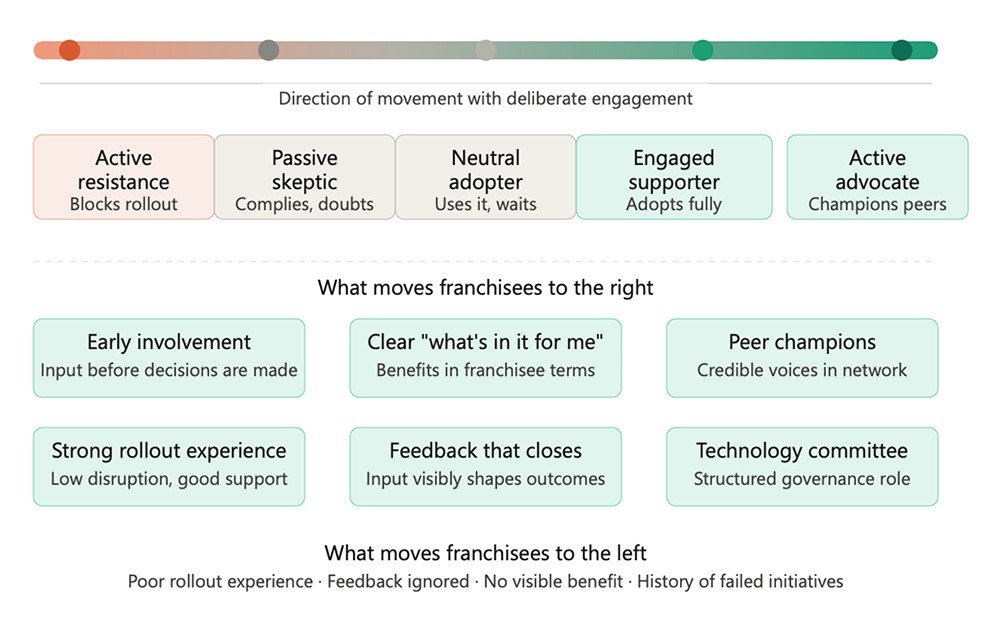
Franchisees were informed, not involved. There is a significant difference between telling franchisees what is coming and engaging them in shaping what comes. When franchisees feel like technology decisions are being made for them rather than with them, resistance is a natural response, even when the technology itself is sound.
The “what’s in it for me” question was never answered. Corporate teams often communicate technology initiatives in terms of what they deliver for the brand or for corporate operations. Franchisees are thinking about their location, their staff, and their margin. If the communication does not address those concerns directly, the initiative starts with a credibility gap it may never recover from.
The rollout assumed capability that did not exist. Franchisees operate at different levels of technology sophistication. A rollout plan that works smoothly for a tech-savvy multi-unit operator can be a source of significant stress for a single-unit owner with a small team and limited IT support. When the implementation experience is poor, the technology gets blamed even when the real issue was inadequate preparation.
Adoption was declared, not measured. Many franchise systems roll out a new platform, conduct a training session, and consider the initiative complete without assessing what happened at the location level. Is the system is being used as intended? Have workarounds crept back into the process? Are franchisees not asking questions? Often times, the effectiveness of a roll out isn’t assessed until a problem surfaces.
Trust was not established before the ask was made. Franchisees who have experienced poorly executed technology initiatives in the past carry that history into every new rollout. If corporate has not rebuilt trust through transparency, follow-through, and genuine responsiveness to feedback, skepticism is the starting point for every new initiative.
The Tsource Perspective
How We Think About Franchisee Buy-In as a Strategic Discipline
Buy-in is not something that happens to a technology initiative. It is something that has to be built deliberately, over time, starting well before the first system goes live. Here is how we approach it.
Start the Conversation Before You Have the Answer
The single most effective thing a franchisor can do to improve technology adoption is involve franchisees in the process of identifying the problem before presenting the solution. When franchisees have been part of articulating what is broken, what is creating friction in their day-to-day operations, and what they wish the technology did better, they have a stake in the outcome. They are not evaluating someone else’s decision. They are watching their own input take shape.
This does not mean franchisees should design the technology. It means they should be heard before the design begins. The assessment phase of a technology roadmap engagement is the natural moment for these structured conversations with a representative cross-section of franchisees that surface operational realities corporate may not have full visibility into, and that signal to the network that their perspective genuinely influences the direction.
Build a Franchisee Technology Committee
One of the most durable structures for sustaining franchisee engagement across a technology roadmap is a formal franchisee technology committee, a standing group of operators, representing different market sizes, tenure levels, and operational profiles, who participate in technology planning on an ongoing basis.
The committee serves multiple functions simultaneously. It provides corporate with a reliable channel for franchisee input before decisions are finalized. It gives franchisees who are engaged and credible within the network a formal role in shaping technology direction and provides a communication bridge between corporate and the broader franchise system. When franchisees hear about a new initiative from a peer they respect rather than from a corporate memo, the message lands differently.
The committee is not a rubber stamp. It is a genuine governance structure, with a defined cadence, clear accountability for input and feedback, and visible evidence that participation influences outcomes.
Translate Every Initiative Into Franchisee Terms
Every technology initiative on a corporate roadmap has a corporate rationale whether its improved visibility, reduced overhead, or better data. Those are real benefits. But they are not the benefits franchisees are asking about.
Franchisees want to know: Will this make my daily operations easier or harder? Will my staff be able to use it without constant support? What does it cost me in time, in training, and in disruption to make this change? And what do I get on the other side?
Every major rollout should have a clear, honest answer to each of those questions communicated in language that reflects the franchisee’s perspective. The communication plan is not an afterthought to the technology plan. It is an equal part of it.
Sequence Rollouts to Build Confidence
The order in which technology initiatives are rolled out across a franchise network has a significant influence on adoption. Initiatives that are straightforward to implement, deliver visible benefit quickly, and create minimal disruption build organizational confidence and goodwill. Initiatives that are complex, disruptive, or slow to deliver visible value deplete it.
This argues for sequencing rollouts deliberately, starting with the initiatives most likely to produce early wins and visible franchisee benefit, and using that goodwill to create the runway for harder changes later. The roadmap should reflect this logic, not just the internal priority order that makes sense from a systems architecture perspective.
Create Feedback Loops That Actually Close
Franchisees who provide feedback and never see evidence that it was heard stop providing feedback. Worse, they stop engaging with the process. Building genuine feedback loops such as regular check-ins during implementation, structured surveys after rollout, visible reporting back on what was heard and what changed as a result is what sustains franchisee engagement across the full arc of a technology roadmap, not just at the beginning.
This is also how trust gets rebuilt with networks that have experienced poor technology rollouts in the past. Not through promises, but through a demonstrated pattern of listening, responding, and following through.
Identify and Activate Internal Champions
In every franchise network, there are operators who are naturally curious about technology, early adopters who are willing to try new systems before the broader rollout, and voices that carry credibility within the franchisee community. These individuals are among the most valuable assets a franchisor has in a technology change initiative.
Engaging them early by involving them in pilot programs, incorporating their feedback visibly, and giving them a role in communicating to peers creates a credible, ground-level voice for the initiative that corporate communications cannot replicate. When a franchisee hears from another franchisee that a new system made a real difference in their location, it is a fundamentally different message than when they hear it from corporate.
Ask us about how Tsource structures franchisee engagement as part of our technology assessment and roadmap engagements — including how we have helped organizations stand up franchisee technology committees that sustain adoption over time.
Real-World Application
Building Franchisee Buy-In as a Deliberate Outcome
Any Lab Test Now, a national healthcare franchise with over 200 locations, faced a technology challenge that was as much about people as it was about systems. Managing pricing across over 8,000 lab tests, approximately 30 lab partners, and hundreds of franchise locations each, with their own local market considerations, required a solution that franchisees would actually use consistently across the network.
Building that solution was one part of the challenge. Getting franchisees to trust it, adopt it, and engage with it as a tool that worked for their location was another.
From the outset, the technology roadmap that guided the engagement was treated as a communication tool as much as a planning document. It gave franchisees visibility into where the technology was going and why, created a shared frame of reference for corporate and franchisee conversations about technology priorities, and demonstrated that investment decisions were being made with a clear long-term strategy rather than reactively.

The result was a level of franchisee buy-in on technology objectives that the organization had not previously achieved. The CEO reflected on the outcome directly:


“Tsource has been a wonderful addition to our team. With their vast knowledge and experience, we have been able to improve our technology infrastructure and get franchisee buy-in on our technology objectives.”
The Pricing Portal that emerged from the roadmap was adopted across the network not just because it was well-built, but because franchisees had been part of the conversation that shaped it and because the rollout was managed in a way that reflected their operational reality rather than assuming it away.
Takeaways and Action Steps
What to Walk Away With
- Buy-in is built before the rollout, not during it. The franchisees most likely to adopt new technology are the ones who were involved in identifying the problem it solves. Engagement starts at the assessment phase, not the implementation phase.
- A franchisee technology committee is one of the highest-leverage structures a franchisor can build. It creates a durable channel for input, a credible peer voice for new initiatives, and a governance structure that sustains engagement across the full arc of a technology roadmap.
- Communicate every initiative in franchisee terms. The corporate rationale for a technology decision is not the franchisee rationale. Both need to be articulated clearly and the franchisee version needs to be developed with the same rigor as the business case.
- Sequence rollouts to build confidence, not just technical efficiency. Early wins create the goodwill and organizational trust that make harder changes possible. The roadmap should reflect this.
- Feedback loops that close are what sustain engagement over time. Franchisees who see their input reflected in outcomes keep participating. Those who do not stop.
The hardest part of a technology roadmap has nothing to do with technology. It has everything to do with people and the franchisors who treat buy-in as a strategic discipline consistently outperform those who treat it as a communication task.

FAQs
As early as possible, ideally during the assessment phase, before any technology decisions have been made. Franchisees who are involved in articulating the problem have a stake in the solution. Those who are informed of a decision after it has been made are evaluating it as an outsider, which is a much harder position to convert into genuine adoption.
A well-structured committee has a defined membership that represents the diversity of the franchise network, different market sizes, ownership models, and tenure levels. It meets on a regular cadence, has a clear mandate to provide input on technology priorities and initiatives, and has visible evidence that its input influences outcomes. The committee should not be purely advisory in name, it should have a genuine role in shaping direction, or franchisee participation will erode quickly.
Address the resistance directly and specifically rather than trying to work around it. Understand what is driving it and whether it is a concern about cost, capability, disruption, or something else. Respond to that specific concern with honesty. In some cases, piloting the initiative with willing operators and sharing the results with skeptics is more persuasive than any communication effort. In others, the concern reflects a real implementation gap that needs to be addressed before the broader rollout proceeds.
Usage data from the platform itself is the most reliable indicators. Are franchisees logging in and using the features as intended? Are franchisees reverting to workarounds? Beyond usage data, structured check-ins with a sample of franchisees at 30, 60, and 90 days post-launch surface qualitative feedback that usage data alone does not capture. Both are needed for a complete picture of adoption health.